CONTAGIONISM IN HISTORY
Welcome to this website. I created this site to make my articles available to other Independent Scholars. I hope to add other materials relevant to the history of contagionism and contagious diseases.
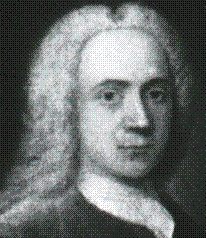
The picture is a detail of a portrait by William Hogarth thought to be of his friend Dr. John Fothergill. As a member of the Society of Friends, Fothergill refused to sit for his portrait, so Hogarth probably painted him from memory.
Margaret DeLacy 11/07/2022
MY BOOKS
The Germ of an Idea: Contagionism, Religion and Society, 1660-1730, Palgrave Macmillan: 2016
Contagionism Catches On: Medical Ideology in Britain, 1730-1800, Palgrave Macmillan: 2017
MY ARTICLES
Unpublished papers/data
Benjamin Franklin and eighteenth-century contagionism
English Religious Laws passed between 1660 and 1728
Timeline of policies/admissions of fellows to the London College of Physicians, 1658-1800
Contagion and the Royal Society, 1657-1723 (data for a paper given to the American Association for the History of Medicine)
Contagion in Manchester (24th International Congress of History of Science, Technology and Medicine (iCHSTM 2013), Manchester, UK 21-28 July 2013
Preventing Contagion: Advice to the Poor (excerpts from John Ferriar of Manchester, John Clark of Newcastle, the Rev. William Clerke of Bury and Francis Barker, of Waterford)Published papers and articles
Nosology, Mortality and Disease Theory in the Eighteenth Century
Influenza Research and the Medical Profession in Eighteenth Century Britain
The Conceptualization of Influenza in Eighteenth-Century Britain: Specificity and Contagion
Puerperal Fever in Eighteenth-Century Britain
with A. J. Cain: A Linnaean thesis concerning Contagium vivum: the 'Exanthemata viva' of John Nyander and its place in contemporary thought (.pdf from the National Library of Medicine)
Voluntary Vaccination: Deciding the Risk of Unknowable Danger
Google NGram of the word "Contagion"
The first peak shown on this graph, in the 1650s appears to be dominated by the metaphoric use of contagion (e.g. the contagion of sin, the contagion of heresies) and to reflect an increase in religious and political tracts during the Interregnum; the second peak, about 1800, is due to medical controversies over whether acute diseases such as jail fever were contagious.
BOOKS AND ARTICLES BY OTHER AUTHORS
Primary works
These works used to be available online through Google books. Unfortunately, some of them have been taken offline.
Anon. A New Discovery of the Nature of the Plague . . . Contrary to the Opinion of Dr. Meade, [sic] Dr. Browne, and others, who give for the First Causes of the Plague . . . Air, Diet, and Disease
(London: T. Bickerton and J. Wilford, n.d. preface dated Aug. 31, 1721
This very rare book is not, strictly speaking, a contagionist work. It attributed plague to "a subtle active poisonous Body or Insect, very minute ... living on and subsisting by the virulent Matter in the body ... the Air being no more to it, than it is to Birds. The author, who frequently refers to the similar views of Richard Bradley, suggests that the smaller insects are, the faster they multiply, explaining why plague kills its victims so quickly. He points out that inanimate particles can't move of their own accord and they become weakened, not increased in power, when they impart their qualities to another body. Despite Mead's theory that the plague consisted of small venomous particles, bodies could not absorb particles through the pores in the skin because the body constantly exhales through them. The fact that no epidemic had taken place in England for more than half a century despite many earthquakes, floods, storms, sieges and bad weather showed that these events did not cause the plague. Similarly, there were many starving and sick people who did not contract plague. In the second portion of this book, as if he had completely forgotten the argument he had just made, the author blames the bad air emanating from large, closely packed groups of people. He suggested that the existence of many prison galleys in Marseilles led to the epidemic there and suggested that the largest source for the problem in London was the presence of many prisons within the city. He called for the removal of criminals to prisons outside the city and for the release of debtors from debtors' prison. The vehemence of his discussion of the plight of London debtors suggests that this advice may have been self-interested, but it was probably sound advice nevertheless.
M.A.C.D. [?Robert Boyle] Systême d'un Medicin Anglois sur la Cause de Toutes Les Especes de Maladies, Avec Les Surprenantes Configurations Des differentes especes de petits Insectes, qu'on voit par le moyen d'un bon Microscope dan le Sang & dan les Urines des differens Malades, & même de tous ceux qui doivent le devenir Recueilli par M.A.C.D. (Paris: Alexis-Xavier-Rene Mesnier, 1726)
"The system of an English Doctor on the cause of all sorts of diseases with the surprising appearances of different species of small Insects, which can be seen by the means of a good Microscope in the Blood and in the Urine of different patients, and also in all those who will become ill"
This entertaining treatise, reported to be by a quack physician and juggler called Robert Boyle, Boile or Boil, claims to be a translation of the third part of a treatise entitled "Systems of an English Doctor, on the nature of God & of Souls, on the Generation of every thing, on the cause of all sorts of Maladies, and on their cure, collected and made intelligible... to everyone". The author explains that he has only translated the third part because the first part (on the nature of God) would be contrary to the revealed truth of our religion, the second (on generation) would wound the modesty of the chaste, and the fourth (on medicine) would not only make all men their own doctors but also all women.
The Google version, which is digitized from a copy in the University of Lausanne (2009) includes a sequel, "Suite du Systeme d'un Medicine Anglois, sur la Guerison des Maladies, par lequel sont indiquees les especes de Vegetaux & Mineraux, qui sont des Poisons infallibles pour tuer les differentes especes de petits Animaux, qui causent nos Maladies, Recueilli par M.A.C.D. (Paris, Mesnier: 1727)
"The sequel of the System of an English Doctor on the Cure of Illnesses, by which is indicated the sorts of Vegetables and Minerals which are unfailing poisons for kill the different species of small Animals which cause our diseases".
This attributes the earlier work to conversations the author had had with an English doctor, coming from Ispaham (Isfahan) who had been passing through Europe with the Persian Ambassador in 1715.
For the story of this work, see William Bulloch, History of Bacteriology (1938, Dover edn, New York: 1979), p. 32.
William Godwin, Diary. A splendid new annotated online edition of Godwin's diary from the Bodleian Library.
E. H. Griffith, "The Germ Theory" Griffith reported that, as Charles Singer would later do, he was browsing in an antiquarian shop (this one was in Pike's Peak) when he stumbled on a copy of Marten's work and was transfixed. This article, from the American Microscopical Journal of 1891, was reprinted twice in other local medical publications, one in St. Louis and the other in Michigan. The author was presumably Ezra Hollace Griffith, a microscopist, inventor of the "Griffith Stand" and frequent contributor to the journal. Griffith wrote that "The germ theory of disease is generally supposed to be new, and I do not now recall any one who knows it was advocated prior to 25 years ago [i.e. c. 1865]."
This is a good example of one of those recurrent waves of collective amnesia that often overtook the medical profession.
Benjamin Marten, A New Theory of Consumptions, More especially of a Phthisis or Consumption of the Lungs (London: 1720). The first complete account of Contagium Vivum by an English author. The first edition appeared in 1720; a second ed. appeared in 1722.
Richard Mead, A Short Discourse Concerning Pestilential Contagion and the Methods to be Used to Prevent it London: Printed for Sam. Buckley in Amen-Corner and Ralph Smith at the Royal-Exchange, 1720.
There were nine editions; the last was in 1744. The book is dedicated to James Craggs, Secretary of State, who would soon become implicated in the scandal over the bursting of the South Sea Bubble. Craggs lost his son to smallpox in February, 1721 and died one month later of a stroke.
For more on this work, see Charles-Edward Amory Winslow, The Conquest of Epidemic Disease (Princeton, 1943) and Arnold Zuckerman, "Plague and contagionism in eighteenth-century England: the role of Richard Mead", Bulletin of the History of Medicine 2004 Summer;78(2):273-308.
Proceedings of the Board of Health in Manchester (Manchester: Printed by S. Russell for Cadell and Davis ca. 1805)
This interesting title, now on the Open Collections program on Contagion from the Countway Library at Harvard is accessible from an extremely annoying, slow and balky page viewer. If you can, download a .pdf and read from that. They should let Google Books provide it.
Classic Secondary Works
H[ector] Grasset, "La théorie parasitaire et la phthisie pulmonaire au XVIIIe Siècle", France Médicale (Nov. 17, 1899), translated by Thomas C. Minor as "The Parasitic Theory and Pulmonary Phthisis in the Eighteenth Century" Cincinnati Lancet-Clinic, n.s. 44 93: (Jan. 6, 1900), 22-26 and (Jan. 13, 1900), 43.
This is very helpful historical review of eighteenth-century contagionist works. Unfortunately, several proper nouns are misspelled in the Minor translation, making it harder to find the article through Google searches. As far as I know, 20th. century historians were unaware of this article. I have not been able to locate the original French, version.
William MacMichael, "A Brief Sketch of the Progress of Opinion on the Subject of Contagion; with some Remarks on Quarantine"
http://pds.lib.harvard.edu/pds/temp/async/6735384-1-14.pdf
The URL points to the text provided by the Harvard University Library website for "Contagion: Historical Views of Diseases and Epidemics". This copy, which begins on p. 519 of an unnamed source (perhaps The Pamphleteer) appears to be the same as a work listed by Google Books as being published in London by John Murray in 1826, but the Google link does not provide a text. MacMichael wrote this work in an effort to refute the arguments of Charles MacLean who had called for an end to quarantines against Plague. In this short work MacMichael analyzes the views of several British authors about the contagiousness of several febrile diseases including smallpox and scarlet fever.
Classic Articles
Plague
Other Diseases
Classic articles
Charles Singer, "Notes on the Early History of Microscopy" Proceedings of the Royal Society of Medicine (1914) (Section of the History of Medicine) 7: 247–279. PMCID: PMC2003539
A rare full-text public-access copy of one of Singer's early articles courtesy of PubMed
Plague
Achtman, Mark, Morelli, Giovanna, Zhu Peixuan et. al. "Microevolution and history of the plague bacillus, Yersinia pestis" Proc. National Academy of Sciences, U.S. A., December 21, 2004;
101(51): 17837–17842. Published online 2004 December 14. doi: 10.1073/pnas.0408026101 http://www.ncbi.nlm.nih.gov/pmc/articles/PMC535704/
Ayyadurai S, Sebbane F, Raoult D, Drancourt M. "Body lice, Yersinia pestis Orientalis, and Black Death" [letter]. Emerg Infect Dis [serial on the Internet]. May, 2010 .
http://www.cdc.gov/EID/content/16/5/892.htm
http://www.ncbi.nlm.nih.gov/pmc/articles/PMC2953993/?tool=pubmed
"Paleomicrobiology suggested that most historical cases in Europe resulted from Orientalis....Our data support an alternative scenario of the historical plague epidemics transmitted by body lice, with Orientalis being the only such louse-borne transmissible biotype."
Dean, Katharine, Fabienne Krauer, Lars Walloe et. al.,
"Human ectoparasites and the spread of plague in Europe during the Second Pandemic""we demonstrate that human ectoparasites appear to have been the dominant transmission mode for plague during the Second Pandemic. This alternative mode of transmission could account for many of the epidemio-
logical differences between the Second Pandemic and those caused by rats during the Third Pandemic."
https://www.researchgate.net/publication/322532230
Stephanie Haensch, Raffaella Bianucci, Michel Signoli, et. al, "Distinct Clones of Yersinia pestis Caused the Black Death" Oct 7, 2010 PLoS Pathog 6(10): e1001134. doi:10.1371/journal.ppat.1001134
WEBSITES AND BLOGS
The Age of Revolutions: A cooperative blog providing essays on the cultural history of the idea of revolution.
Alun Withey's blog maintained by Alun Withey, a historian of medicine, culture and the body in the eighteenth century.
"Applying new Methods with GIS/Space-time/behavior in medical Geography" one of many fascinating sets of webpages by Brian Altonen. See also his Pinterest board of historical disease maps
Art UK: huge searchable collection of images from British collections contributed by more than 3,000 institutions
"Black Death" page on medievalists. net
"Books, Health and History" from the New York Academy of Medicine
"British Libary blogs" a collection of blogs by members of the British Library staff focusing on British Library collections
"Celebrating Jewish Archives" Guide to a consortium of Jewish Archives in Britain
Connected Histories service that conducts simultaneous search through more than two dozen digital history databases and archives covering British history 1500-1900. Can be frustrating, especially for non-UK citizens, when results point to paywalled archives (such as Gale collections) but amazingly efficient at searching.
Contagion: Historical Views of Diseases and Epidemics From Harvard University, a selection of open-source texts. Gives relatively little attention to eighteenth-century British works
Contagions blog by Michelle Ziegler
The Cullen Project The Consultation Letters of Dr William Cullen (1710-1790) at the Royal College of Physicians of Edinburgh.
Dalhousie University, History of Medicine Resources comprehensive list of major medical resources
Digital Collections from the National Library of Medicine. Repository of public domain materials in biomedical history
Dissenting Academies: a list on the website "Technical Education Matters" created by Dr. Richard Evans
Early Modern History Resources from MEMSLib at the University of Kent
Early Modern Online Bibliography a blog developed by Anna Battigelli (SUNY Plattsburgh) and Eleanor Shevlin (West Chester University of Pennsylvania) to facilitate scholarly feedback and discussion pertaining to text databases for the humanities, such as EEBO, ECCO, and the Burney Collection.
Early Modern Practitioners a database in progress with biographies of medical practitioners in England, Wales and Ireland, c.1500-1715 hosted by the Centre for Medical History (CHM) at Exeter University
Early Modern Online Recipes Collection (EMROC) a project to recover, transcribe, and analyse early modern recipe books, many containing medical recipes and/or advice
Eighteenth Century Common a website providing discussions by eighteenth-century scholars about their work, targeted for the general reader.
The Galileo Project: Catalog of the Scientific Community in the 16th. and 17th. Centuries compiled by Richard S. Westfall
History of the Health Sciences World Wide Web Links compiled by Patricia E. Gallagher and Stephen J. Greenberg, a comprehensive listing of major medical history web resources including blogs, journals, biographies of individuals, and sites for particular diseases
History of Medicine in Ireland blog: A collection of short articles and events hosted by the Centre for the History of Medicine in Ireland, University College Dublin and the Royal College of Physicians of Ireland Heritage Centre.
Hyde Collection Catablog: Provided by the Houghton Library at Harvard University, this blog centers on the Hyde Collection of material on Samuel Johnson.
Infectious Diseases: an online exhibit by the Edward Worth Library in Dublin. Includes sections for Plague, Smallpox, Syphilis, Tuberculosis, Fevers and Theory of Contagion with a well-researched text.
Isis Current Bibliography Eplore. Citations and more for works in the history of Science, Medicine and Technology in this compilation of the Isis Current Bibliography. The Isis Cumulative Bibliography, 1913-1975 will eventually be merged with this database.
John Rylands Library Special Collections blog Posts by Karen Rushton discuss a variety of eighteenth- and nineteenth-century medical topics that are illuminated by holdings in the John Rylands library in Manchester including botany, midwifery, and Manchester doctors. See also the John Rylands Research Institute medical collections website which states that the collections include twenty separate medical archives.
Map of Early Modern London (MoEML) Blog and website including an interactive map and gazetteer that explore the use of GIS data to uncoverthe meaning and representation of cultural and geographic space in the London of Shakespeare and his contemporaries.
Medical Heritage Library a digital library of works in the history of medicine curated by a consortium
of large research libraries including the National Library of Medicine
Medical Humanities Dissertations: Compiled by John Erlen of the University of Pittsburgh, monthly listings of dissertations classified by topic.
Medical Humanities and Medical History Blogs: Large Compilation from McMaster University
MedPlag: Medieval Plagues: Ecology, Transmission Modalities and Routes of the Infections: research project website
Publishing the Philosophical Transactions: a project and accompanying blog housed at the University of St. Andrews on the economic, social and cultural history of the Philosophical Transactions of the Royal Society.
Oregon Rare Books Initiative a blog from the Rare Books collection of the Knight Library at the University of Oregon including scheduled lectures.
Othemeralia: Blog from the Othmer Library of Chemical History at the Chemical Heritage Foundation in Pennsylvania
Quarantine Studies: This is a Wordpress blog for a group of scholars interested in the history of Quarantines and Lazarettos. Their focus seems to be the Mediterranean. They have created an associated list of reference materials on Zotero .
Pandemics in Historical Perspective: A Bibliography for Evaluating the Impacts of Diseases Past and Present by Hannah Johnston, NYAM Library Volunteer, June 2020. Annotated bibliography of works published between 2000 and 2020.
The Recipes Project: website and associated media devoted to studying the meaning and use of recipes in Food, Magic, Science, Art and Medicine
Remedia: a history of medicine blog from Harvard University
The Repository: the History of Science blog of the Royal Society
Shells and Pebbles: a History of Science blog from the Netherlands
Six Degrees of Francis Bacon Created by teams at Georgetown and Carnegie Mellon, this innovative project maps and displays early modern social networks. The inital diagrams were based on the Oxford Dictionary of National Biography but the interface supports crowdsourcing, so the amount of information should grow substantially.
The Sloane Letters Blog maintained by historian Lisa Smith at the University of Saskatchewan
Vesalius journal published by the International Society for the History of Medicine (ISHM): all issues except the most recent are available via open access online.
The Voltaire Foundation Blog cooperative blog on Voltaire and the Enlightenment, strongest in French history and culture.
Wellcome Library Blog The blog includes a "blogroll" listing many other health and medicine blogs
"'Where Mis'ry Moans:' Four Prison Reformers in Eighteenth & Nineteenth Century England" An online exhibit by the Harvard Law School Library spotlights my earlier book, Prison Reform in Lancashire which also includes a discussion of the late eighteenth-century typhus epidemic.
HISTORY OF MEDICINE PODCASTS/STREAMING AUDIO AND VIDEO
Several medical libraries and history of medicine institutions host history of medicine lectures periodically. They have begun to make these available as podcasts or streaming audio/video recordings. The technical quality is often poor--amounting to a recorder near the dais in a large auditorium when the lecture is given, but the lectures themselves are often wonderful. I don't know of any source that catalogs/indexes these by speaker or subject or even of any master list of these lectures but here are links to a few libraries that have announced the availability of audio/video records of this sort of event
"Coughs, Sneezes, and Jet-propelled Germs," courtesy of the Public Domain Review and the Internet Archive, here are two (very) short films on using and cleansing handkerchiefs created by Richard Massingham (1898–1953), a former Senior Medical Officer at the London Fever Hospital who also stars in each one.
Images from the Wellcome Library
Medical History "Highlights of a Decade": reflections by authors of Medical History articles
National Library of Medicine History Talks
Oregon Health and Science University, Historical Collections and Archives lecture series
Owsei Temkin on Galenism and Galenics in the History of Medicine
a radio talk "for Doctors Only" broadcast by WNYC in 1957
Oxford Brookes University, "Moments in Medicine"
Reynolds Historical Library, University of Alabama lecture series
This work is licensed under a Creative Commons Attribution-NonCommercial 4.0 International License.
